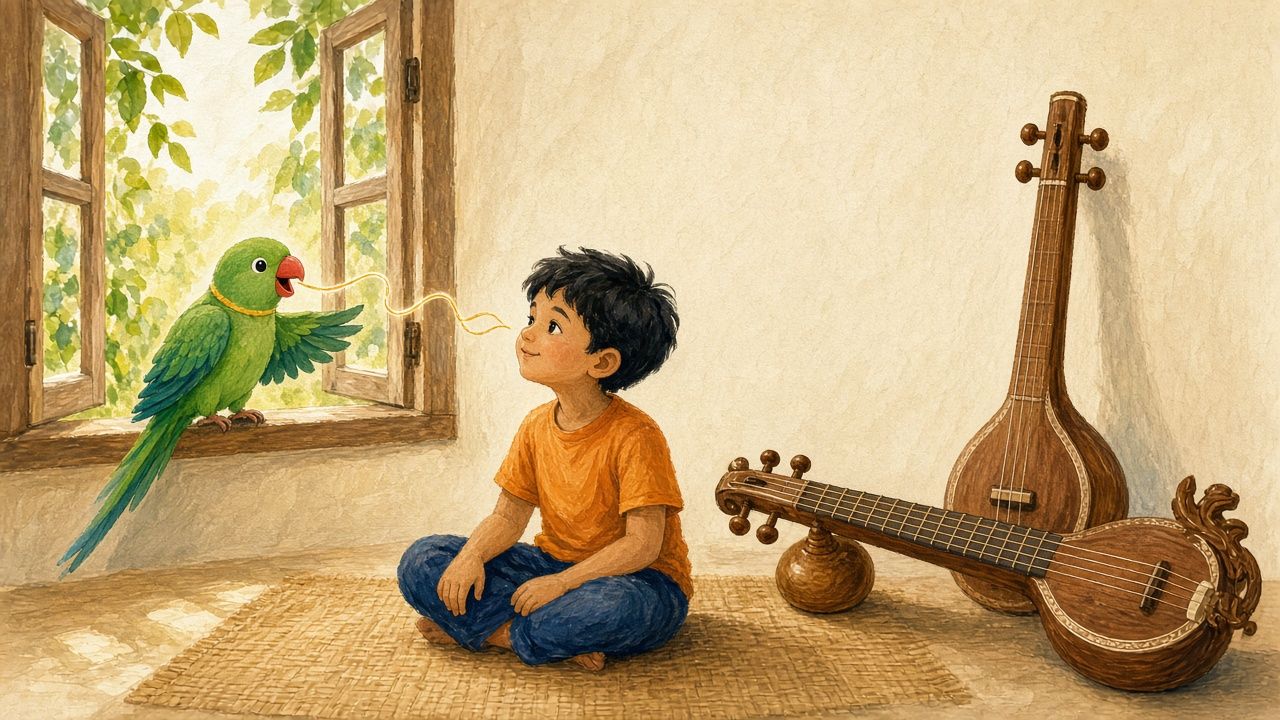
Why listening matters more than you think
Carnatic music is taught by ear. A teacher sings a line and the student sings it back. A child who has heard a lot of this music arrives at class with the sounds already in their head, and the lesson has something to attach to.
That is easy in a home in Chennai, where the music is on the radio, in the temple and at every wedding. It is harder in New Jersey, London, Sydney, Singapore or Dubai, where one class a week may be the only Carnatic music a child hears. Many teachers will tell you the same thing: please play it at home.
The good news is that this is the one part of music lessons a parent can do without any training. You do not need to sing. You need to press play, regularly.
A raga-of-the-day habit
Small and daily works better than long and occasional. A habit that fits a real household might look like this:
- Pick one raga for the day. One is enough. Say its name out loud.
- Hear its scale. Up and down, slowly, over a drone. Let your child hum along.
- Play one short piece in it. At breakfast, in the car, while packing school bags.
- Come back to it. When the same raga comes around again, ask, "Do you remember this one?"
Children aged about 4 to 12 are very good at this kind of recognition. Do not test them. Just keep the music near them, and let the names become familiar. If you want to understand what you are both hearing, read What is a raga?
Tala: the part you can do together
Tala is the rhythm cycle, and it is kept with the hand. Adi tala, the one most children meet first, has eight beats: a clap and three finger counts, then a clap and a wave, twice. It is physical, it is a little like a clapping game, and you can learn it in ten minutes alongside your child.
Keeping tala steadily is where many beginners wobble. Five minutes a day of clapping along, with a parent sitting beside them, does more than one long session on the day before class.
What your child's teacher does, and what you do
The teacher teaches: how to sing each note, which exercises to practice and in what order, and when to move on. That order is theirs to decide, and no app should second-guess it.
Your part is smaller and just as useful:
- Ask the teacher which sruti (home pitch) your child sings at, and use the same one at home.
- Ask which song or raga they are working on, and find a good recording of it to listen to.
- Make practice a short, fixed part of the day, and sit nearby.
- When the teacher uses a word you do not know, look it up. There are fewer of them than you fear.
Where Khamas fits
Khamas is a Carnatic music app for families, on iPhone, iPad and Apple TV. It is written for parents and adult learners, to use together with a child. It is a companion to a teacher, not a replacement: it gives no lessons. What it does is make the daily habit above easy.
- A raga of the day, the same for everyone on the same day.
- Hear the scale: each raga's ascent and descent over a tanpura, at the sruti your teacher uses.
- An animated tala counter showing every clap, finger count and wave, on an iPad or on the family TV.
- A glossary of 73 terms, for the words that come home from class.
- A hand-picked guide to recordings, organized by raga, artist, composer and tala.
See how Khamas works for families.
An honest note about YouTube
Khamas does not play recordings. When you want to hear one, you tap Watch on YouTube, which leaves Khamas and opens the YouTube app or website. Khamas itself has no ads, no accounts and no tracking. YouTube is a separate service with its own ads, recommendations and terms, and it is not designed as a children's service.
So that button is a parent's decision. For a young child, we suggest you do the listening together, and use Screen Time if you want to limit YouTube on their device. The scale player, tala counter, journey and guides all work without it. Our note for parents goes into the details.
Coming soon, and not in the app yet
Two things are planned for children and are not in Khamas today: a step-by-step learning path for children, and Kili, a parakeet guide to keep them company along it. We mention them so you know where Khamas is going. Please do not join expecting them on day one.
Getting started
Khamas is in private testing. Get early access and we will write when there is a place for your family. On Android or a laptop, try Rasika free on the web.
If you are learning alongside your child, Carnatic music for beginners is written for you. And if December is near, our guide to the Margazhi season explains why the family in Chennai is suddenly at concerts every evening. Are you a teacher? See Khamas for teachers.