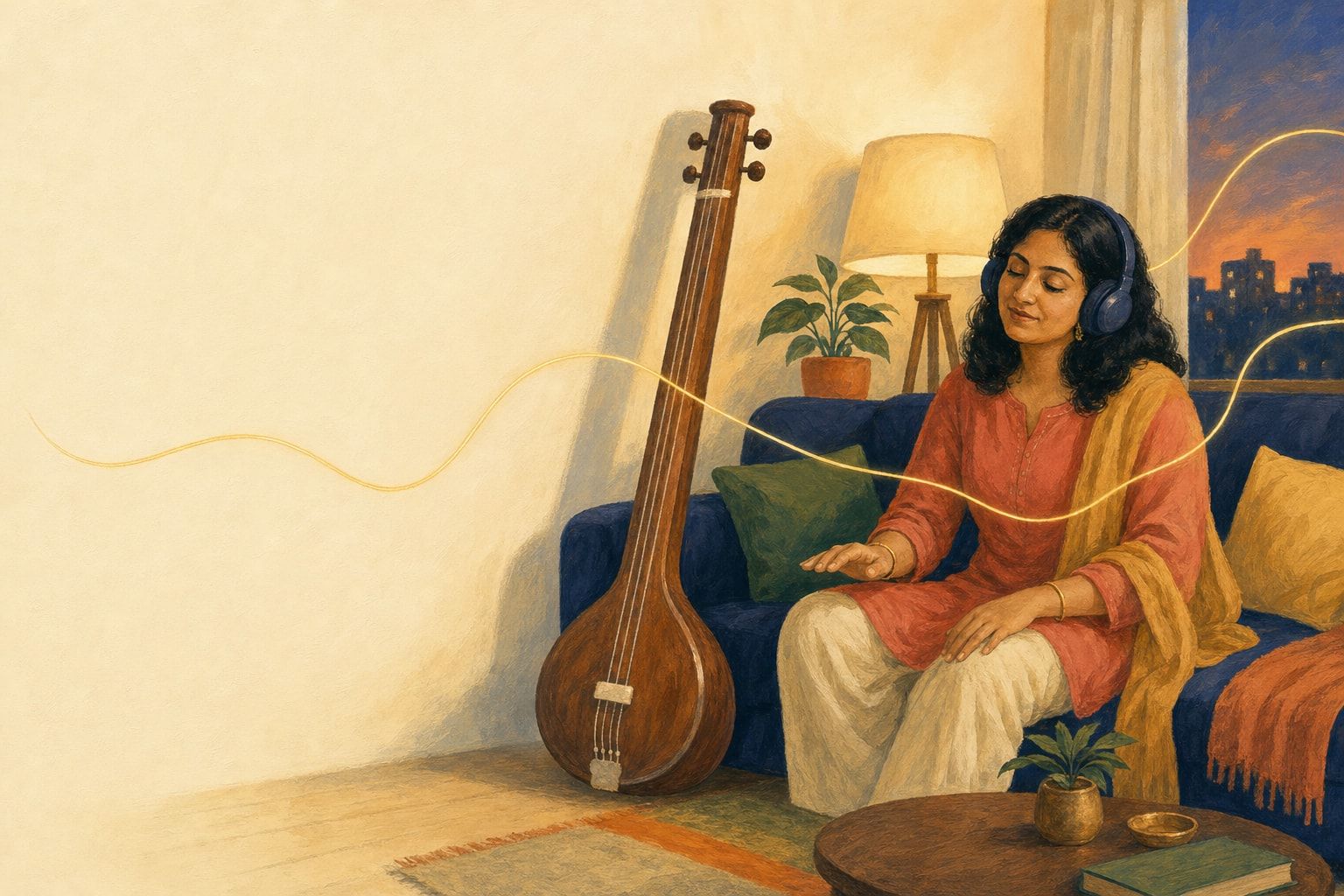
You do not need theory first
Carnatic music is the classical music of South India. It has a deep theory behind it, and people spend lifetimes on that theory. None of it is required to enjoy a song. Children in musical homes learn to recognize ragas the way they learn to recognize faces, by seeing them often, long before anyone explains the rules.
So the plan for a beginner is simple: listen a little, most days, and pick up one new word at a time. The three ideas below are enough to make a concert make sense.
Three ideas that unlock most of it
Raga: the melody's character
A raga is a melodic framework: a set of notes, plus the phrases and ornaments that give them a recognizable personality. Every piece is in a raga, and the musician will usually tell you which. For the longer explanation, with examples, read What is a raga?
Tala: the cycle you keep with your hand
A tala is a repeating cycle of beats. You will see singers and audience members keeping it on their laps with claps, finger counts and waves of the hand. The most common, Adi tala, has eight beats: a clap and three finger counts, then a clap and a wave, twice. Tala is the easiest part to join in with. You can keep Adi tala on your knee on your first day.
The shape of a concert
A Carnatic concert, or kutcheri, usually follows a familiar arc. It often opens with a brisk piece called a varnam. A run of composed songs, called kritis, follows. Somewhere past the middle comes the main piece, where the musicians stretch out and improvise at length, and the percussionists take a solo called the tani avartanam. The last part is lighter and shorter, and the concert closes with a brief mangalam.
Most of the songs you will hear were composed between the 18th century and today, and a few composers come up constantly. Tyagaraja, Muthuswami Dikshitar and Syama Sastri are known together as the Trinity, and you will hear their names in almost every concert.
A simple way to start
- One raga at a time. Pick a raga, hear its scale, and listen to one short piece in it. Tomorrow, pick another, or the same one again.
- Start with short items. A five-minute kriti is a better first listen than a forty-minute main piece. Bright five-note ragas such as Mohanam and Hamsadhwani are friendly places to begin.
- Keep the tala. Count Adi tala along with a song. When you lose your place, wait for the next cycle and start again. Everybody loses their place.
- Follow a path. After a few weeks, try a whole concert from start to finish, and see how many parts of it you can name.
Words you will keep hearing
- Sruti: the home pitch a musician chooses, held underneath by the tanpura's drone.
- Kriti: a composed song, the main kind of piece in a concert.
- Alapana: a slow, wordless improvisation that introduces a raga before the song begins.
- Gamaka: the slides and oscillations that ornament a note.
- Mridangam: the two-headed drum that accompanies most concerts.
How Khamas helps
Khamas is a listening guide and practice companion built for exactly this stage. It does not play the music itself. It tells you what to hear and why, and each recording has a Watch on YouTube button that leaves the app and opens the recording on YouTube. What runs inside Khamas is everything around the listening:
- A raga of the day, so you never have to decide where to begin.
- Hear the scale: any raga's ascent and descent over a tanpura, at the sruti you choose.
- An animated tala counter that shows every clap, finger count and wave.
- An 8-week Listening Journey that runs from bright five-note ragas in the first week to following a whole concert in the seventh.
- A glossary of 73 terms, and guides to concerts, instruments and the December Season.
Khamas is in private testing on iPhone, iPad and Apple TV. Get early access and we will write when there is a place for you.
Not on an Apple device?
Rasika is our free web app, and it works in any browser, on Android, a laptop or anything else. You can start there today.
More questions? The FAQ covers devices, privacy and how Khamas works with YouTube. And if you are learning alongside a child, see Carnatic music with children and Khamas for families.